|
"Why the Binghamton Inebriate Asylum Suspended" 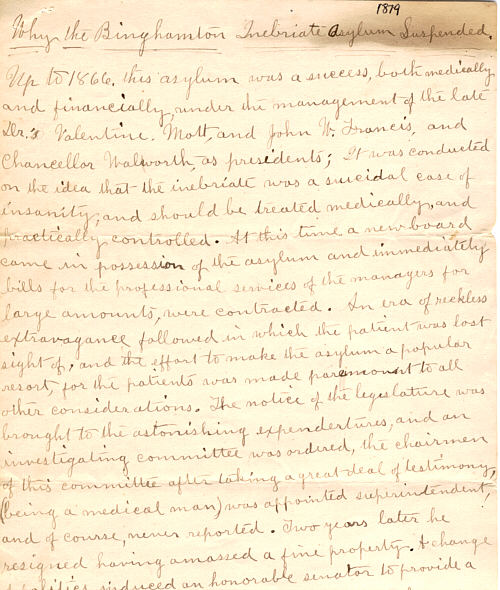 Courtesy Broome County Historical Society |
|
Up to 1866 this asylum was a success, both medically and financially, under the management of the late Dr.'s Valentine Mott, and John W. Francis, and Chancellor Walworth, as presidents. It was conducted on the idea that the inebriate was a suicidal case of insanity, and should be treated medically, and practically controlled. At this time (1866) a new board came in possession of the asylum and immediately bills for the professional services of the managers for large amounts, were contracted. An era of reckless extravagance followed in which the patient was lost sight of, and the effort to make the asylum a popular resort, for the patients was made paramount to all other considerations. The notice of the legislature was brought to the astonishing expendertures, and an investigating committee was ordered, the chairman of this committee after taking a great deal of testimony, (being a medical man) was appointed superintendent, and of course, never reported. Two years later he resigned having amassed a fine property.
A change of politics induced an honorable senator to provide a place for an imprecurious medical friend, who was accordingly elected superintendent. Another investigating committee was by this means strangled in its infancy, by the senator above mentioned. Another political change two years later, and the "magic cipher influence", brought the former superintendent back again, to further enrich himself and friends. At this time began the "masterly strategy" of keeping two setts of books, not-known in ordinary double entry. The plain english of which was charging one sum, and recieving another, the ballance of which was divided among the officers. Two years after this astute superintendent retired with greater wealth.
The "Utica Asylum ring", which had been watching for a long time to share the honors and profits, and possess the building for the insane, and thus save this building from becoming a resort for the chronic incurables, now put forward their favorite as superintendent, with the purpose of "wrecking the asylum" in public estimation. They calculated closely, for the superintendent had been turned out of one hospital for drunkenness, and now after a year he was notoriously worse as an inebriate, than the patients he was supposed to cure; accordingly he was deposed, and the object of the "ring" made clear, when they began to announce the asylum a failure, and whisper to the Governor, that he should suspend its operations.
The friends of the asylum rallied once more, and another superintendent was appointed. He began honestly to build on the ruins of his predecessors, but the local board was indignant, and withdrew all support. A few months later the "ring" convinced the Governor that the asylum was a failure, and he so pronounced it.
During this time over four hundred thousand dollars were received from patients, the records of which are either lost or destroyed; also three hundred and eighty thousand from the State and counties, which was supposed to be expended on the building, very little trace of which can be found; making in all nearly eight hundred thousand dollars, received and expended in this asylum, from 1866 to 1879; an average of over sixty one thousand dollars a year. As an instance of the interest manifested by the board of trustees, the reports show, that fifty eight thousand dollars were paid this board for professional services and traveling expensis, and that they contributed only one hundred and twenty dollars to help on the work. The leading spirit of the board a popular New York landlord, was in receipt during this time as rentals from restaurants, barrooms, and their appurtenances, of over a quarter of a million of dollars.
Such facts as these, show why this asylum was closed, and are eloquent in their mournful suggestiveness. The history of Binghamton Asylum, since the ring through Governor Robbinson declaired it a failure, has furnished another very suggestive chapter worthy of note, and clearly indicates the plans and purposes of the ring which for years has sought to ruin it.
The closing of the asylum was followed by large appropriations to change it to an asylum for chronic insane, in a few weeks time. A year went by, and the "ring" had expended two hundred and fifty thousand dollars, sixty seven thousand only being authorized by the legislature, and the building not half completed yet. Then comes investigation committees. The Governor recommends the removal of the board of managers; the comptroler, the state board of charities, and the Senate investigation committee all urge the removal of the board and yet the Senate by a majority of one retain the managers. The asylum "ring" triumphs, and the same history of fraud and dishonesty repeats itself.
|